> For the complete documentation index, see [llms.txt](https://gitbook.raac.io/llms.txt). Markdown versions of documentation pages are available by appending `.md` to page URLs; this page is available as [Markdown](https://gitbook.raac.io/learn/usdraac-token/tokenomics/ecosystem-token-distribution.md).
# Ecosystem Token Distribution
41.92% of total $RAAC supply is earmarked for the ecosystem.
Ecosystem distributions are done in $leRAAC. $leRAAC is RAAC’s fork of [Clever’s clevCVX](https://docs.aladdin.club/clever), a wrapper for [$veRAAC](/learn/usdraac-token/usdveraac.md). $leRAAC is described in more detail in the [$leRAAC section](/learn/usdraac-token/usdleraac.md).
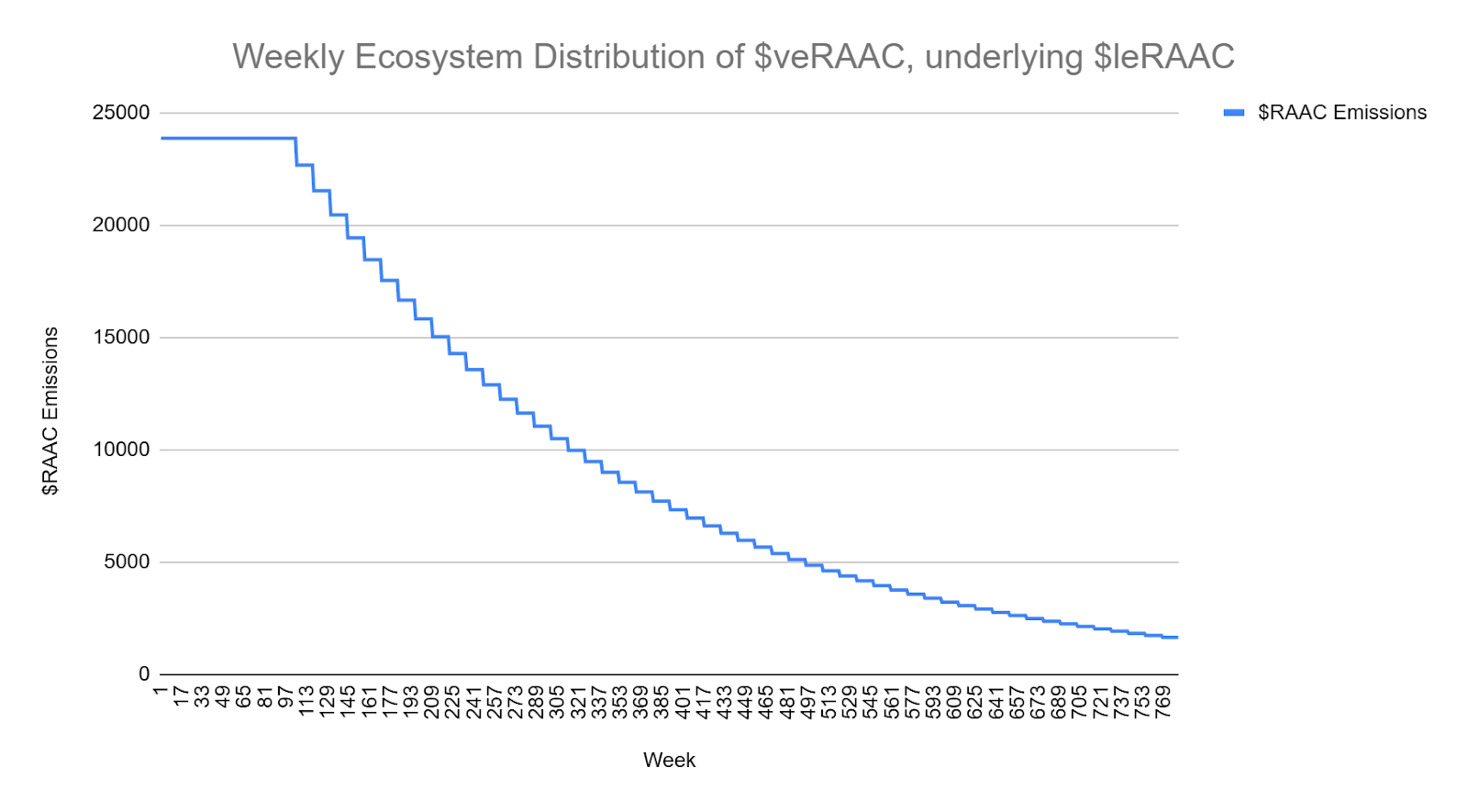
* The amount of $RAAC, underlying the $leRAAC, emitted per week is set upfront on a decaying schedule.
* The first 104 weeks, emissions remain constant
* Afterwards, they are reduced by 5% every 13 weeks, which sums up to approximately a 18.55% reduction per year
* Emissions run for a total of 780 weeks.
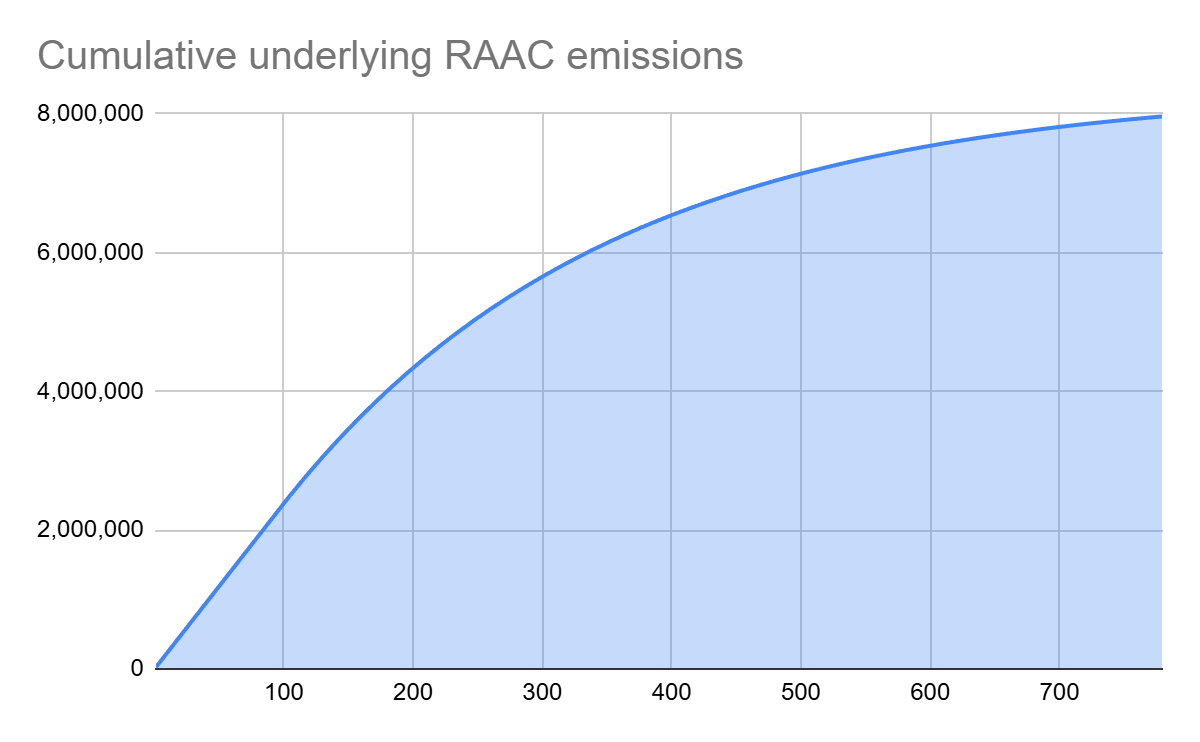
This results in the following emissions schedule:
Ecosystem distributions are frontloaded to kickstart protocol and treasury growth while providing a long-tail of emissions, giving RAAC time to become self-sustaining. After year 1, 15.58% of ecosystem tokens are distributed, 31.15% after year 2, and 44.88% after year 3.
$veRAAC holders decide where ecosystem distributions flow. $RAAC emissions are allocated to [gauges](/learn/usdraac-token/tokenomics/gauges.md) based on the percentage of weekly votes gauges receive.
{% hint style="info" %}
The actual circulating supply depends on multiple factors, including how $leRAAC holders use the mechanics, $veRAAC yield and $RAAC price, and therefore cannot be determined upfront.
{% endhint %}
---
# Agent Instructions
This documentation is published with GitBook. GitBook is the documentation platform designed so that both humans and AI agents can read, navigate, and reason over technical content effectively. Learn more at gitbook.com.
## Querying This Documentation
If you need additional information that is not directly available in this page, you can query the documentation dynamically by asking a question.
Perform an HTTP GET request on the current page URL with the `ask` query parameter, and the optional `goal` query parameter:
```
GET https://gitbook.raac.io/learn/usdraac-token/tokenomics/ecosystem-token-distribution.md?ask=&goal=
```
`ask` is the immediate question: it should be specific, self-contained, and written in natural language.
`goal` is optional and describes the broader end goal you are ultimately trying to accomplish on behalf of the user. GitBook uses it to tailor the answer towards what is most useful for that goal.
The response will contain a direct answer to the question and relevant excerpts and sources from the documentation.
Use this mechanism when the answer is not explicitly present in the current page, you need clarification or additional context, or you want to retrieve related documentation sections.